Clouseau

Forensic document intelligence. On your laptop. For the price of a coffee.

Point Clouseau at a folder of emails, contracts, scans, spreadsheets and bank statements — in any language, including handwriting — and interrogate it in plain English. The agent cross-checks the live web inside the same conversation. Documents never leave your machine.

macOS desktop app. Bring your own Anthropic API key or use a Claude Max subscription.

Clouseau is built for owner-operators, controllers, and forensic accountants who need to understand what's actually in a corpus too large to read manually. It ingests heterogeneous document types, runs vision-grade OCR with structured extraction, and indexes the result locally. From there you can chat with the corpus the way you'd chat with an analyst who'd spent six weeks reading everything.

The Clouseau Overview page — 3,072 documents, 244 vision-OCR'd, 13 unsupervised topic clusters.

Overview of a 3,000-document tea-import corpus — 13 unsupervised topic clusters surfaced automatically.

Findings, not summaries

Insights are framed for the operator — duplicate payments, sequence gaps, undocumented retainers, currency-trail anomalies. Each finding cites the source documents so you can verify in one click.

Operator-facing Insights tab — DPDHL alias drift, undocumented Pinewood consultancy, customs HS-code gaps, Watanabe small-order freight leakage.
Entities tab — staff, supplier contacts, vendors auto-classified.

Who appears where

People and organisations classified by an LLM pass (no brittle keyword rules). The subject company is auto-identified and excluded from counterparty lists.

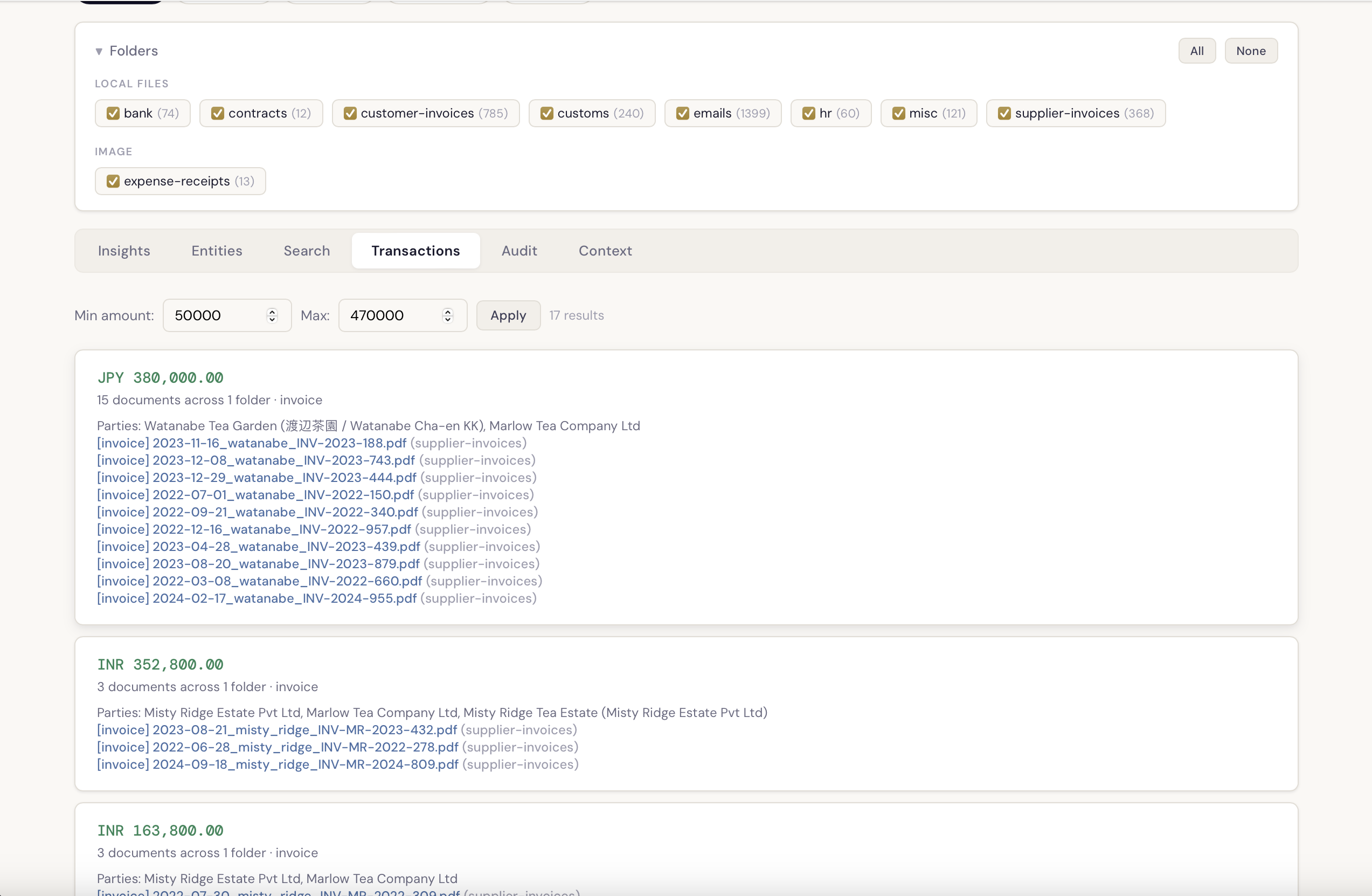
Transaction trails grouped by currency — JPY 380,000 appears in 15 supplier invoices.

Currency-aware trails

Amounts of interest grouped by (currency, value) and traced through every document that mentions them. JPY 380K doesn't get conflated with 380K INR.

Document preview modal — Wise EUR bank statement with structured parties / amounts panel.

One click to the source

Every cited doc opens to the actual file embedded in the modal, with the agent's structured extract — parties, amounts, dates — alongside.

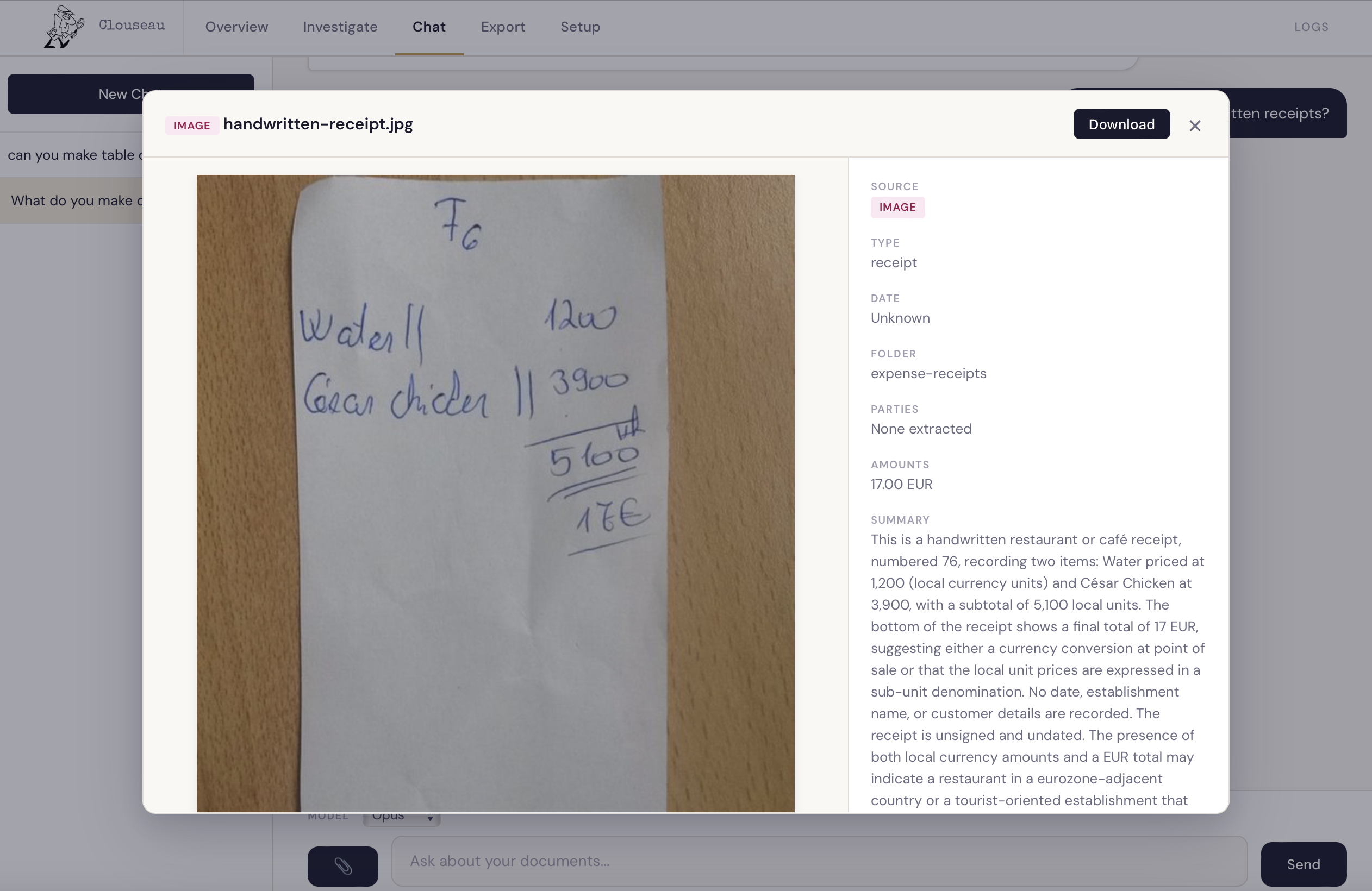
Handwritten Chinese receipt analysed by Claude vision — receipt details extracted into a structured summary.

Multilingual, handwriting too

A handwritten receipt in Chinese, parsed by Claude vision into a structured summary. Same treatment as a typed English invoice.

Findings out, paper in

Tick the answers worth keeping; mark the cited documents worth attaching. One click compiles a report ready for a lawyer or auditor — or bundles the underlying documents into an evidence pack.

A saved investigation report rendered in-app with body + citation appendix.
Bundles tab in Export — Eleanor salary bundle with three cited documents, ready to ship to the lawyer.

What makes it different

Scale that breaks the manual-reading claim.

Index hundreds of thousands of documents on a laptop. The "I could just read it myself" defence stops working past a few hundred docs; Clouseau is built for the order of magnitude beyond that.

Multilingual and handwriting-aware.

Chinese, Japanese, Arabic, Cyrillic, Devanagari, German, mixed-script contracts, handwritten delivery notes. Vision-grade OCR via Claude — reads margin notes, post-its, and non-Latin scripts as readily as English type.

Your documents and the live web, in one conversation.

Cross-check your vendor list against today's OFAC sanctions, your contracts against today's law, your counterparties against this week's news. Live web access alongside the corpus, in one query, with citations to both.

Privacy by location.

Documents stay on your machine. The corpus, the index, the conversations, the attachments — all local. Only the specific question and the retrieved snippets reach the LLM.

Reports in any language, ready for the local file.

Read your English corpus, ask your question in English, hand the answer to your German auditor in German — or your Japanese controller in Japanese. End-to-end multilingual output without the translate-and-paste loop.

Adversarial verification on every finding.

Skeptic, referee, and confidence passes pressure-test each audit finding before you ship it. Avoids the plausible-but-wrong failure mode that hand-rolled LLM tools have.

What a forensic accountant does in six weeks of $300-an-hour reading, Clouseau does on a laptop, in the time it takes to drink a coffee.

Who it's for

The French MD with the Vietnamese subsidiary

Three years of accounting in Vietnamese, supply contracts mixed-language, correspondence with a Japanese sales partner the prior local MD never escalated. Open the corpus, ask 'what should I worry about?' — get back: vendors not in the parent's approved-supplier list, contracts expiring without renewals, a quarterly payment to an entity nobody recognises, customer disputes that never made it to head office.

The controller running monthly anomaly checks

Cron-tab approach for an SME finance lead. Drop the month's documents in, run the audit pass, review the flagged items. Catches things sampling misses: invoices just below approval thresholds, duplicate payments under slightly different names, missing receipts, expense miscategorisations.

The owner-director with a $40k legal dispute

The other side served a demand. A lawyer would charge $15k to do the first-pass document review. Build the evidence pack yourself in a weekend, hand a structured findings document to the lawyer, save most of the fee for the part that actually requires legal training.

The forensic accountant on a fixed-fee engagement

Where every hour of triage is margin. Clouseau gets a 5,000-document case down from a week of reading to half a day of asking. Same final report quality; different cost base.

Case study

Twenty-three minutes inside the Enron emails

Four findings Clouseau surfaced from the public Cohen/CMU Enron release — documented threads that don't appear in the standard secondary literature. The corpus search and the public-record verification ran in the same conversation.

Read the full case study →

See it on your corpus

Thirty minutes. Bring a folder of documents — anything you'd normally read manually.

Book a demo